il
Roman Opalka, Maria Teresa Sartori
Fondazione Querini Stampalia, Venice
May 7 - November 24, 2019
From 7 May to 24 November, the second chapter will involve the rooms of the Querini Stampalia Foundation House Museum, where the works of Roman Opałka and those of Mariateresa Sartori will be related to each other and to those of the institution's ancient collections.
Dire il tempo stems from the desire to deepen Roman Opałka's production through a selection of works that mark fundamental stages in his research, many of which have never been presented before in Italy or have never been exhibited, coming from important private and public collections, including the museum. Muzeum Sztuki of Łódź and above all the Fonds de Dotation Roman Opałka, with which a close collaboration was born in the conception of the project.
Both exhibitions will revolve around OPALKA 1965/1-∞, a research to which the artist has dedicated most of his life and of which the first and last Détail on canvas will be exhibited together for the first time ever: the first from Muzeum Sztuki, Łódź for the first time in Italy, and the last, left unfinished, never presented to the public and coming from Poland, and visible for the
a private collection.
Heart of the Franco-Polish artist's production, OPALKA 1965/1-∞ will be the fulcrum of the exhibition itinerary that will unfold between Milan and Venice covering the entire span of his activity, from the first works to the most recent, making the great I also publish lesser known aspects of his artistic research, but fundamental for his conceptual and linguistic formulation.
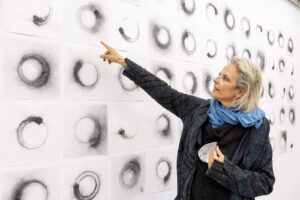
At the Querini Stampalia Foundation, alongside the representations on time by Roman Opałka, a nucleus of works by Mariateresa Sartori (Venice, 1961), an artist from another generation who had developed a deep friendship with Opałka, will be presented. Scattered along the path of the museum, Sartori's drawings and photographic images reveal the subtle and invisible textures determined by our movement in space and through time. At the center of the itinerary is the impressive installation The time of sound. Waves: a wall completely covered with sheets of paper on which the artist, with charcoal, translated the sound of the sea waves in real time into a visual form. The installation will resonate with Opałka's voice as he pronounces the numbers he is painting in Polish.
il
Fabio Mauri, Francesco Jodice, Maria Teresa Sartori, Roman Opalka
Museo della Grafica di Pisa, Palazzo Lanfranchi, Pisa
From 22 December 2017 to 11 May 2018
From 22 December 2017 the Museo della Grafica of Pisa hosts the exhibition Time and works, curated by Massimo Melotti and with works by Roman Opalka, Mariateresa Sartori, Andrea Santarlasci, Fabio Mauri, Giorgio Cugno, Jasmina Metwaly, Federico De Leonardis, Claudio Costa, Francesco Jodice and Gianluca and Massimiliano De Serio.
Organized by the Graphic Museum (Municipality of Pisa and University of Pisa) with the patronage of the Tuscany Region and the Scuola Normale Superiore, the exhibition intends to present artists and trends in contemporary art who have deepened their research on the subject of time.
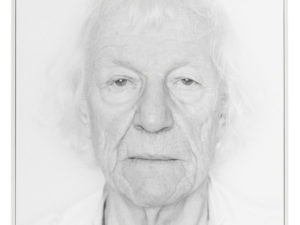
The exhibition stems from the artistic research of Roman Opalka (1931-2011), the artist who most of all tried to define the relationship with time with his work. In 1965 he started his Opalka project 1965/1 - ∞. Throughout his life he has painted a numerical progression on canvases, to which he connects a self-portrait project: he records his own voice pronouncing the newly painted number and takes a picture of himself at the end of each working day. His research on the theme of time ends in 2011 with his death. On display will be presented Détail - Autoportraits and Détail - Cartes de voyage.
By Mariateresa Sartori (1961) the video In G Major / In G Minor is presented, a work on the pervasive power of musical time and on how much this influences not only our feelings but also our visual perception. To do this he uses images taken from Heimat by Edgar Reitz, alternately accompanied by pieces in G major and G minor by Vivaldi and Mozart.
Andrea Santarlasci (1964) invites us to a vision evoked by memory, a vision often played out in a balance between emotionality and conceptuality. The historical experience of the place becomes expressive material that is revealed in the Eterocronia photographic series that opens to a reflection on the present, on the relationship between the individual and memory.
The path continues with the work of Fabio Mauri (1926-2009), the undisputed protagonist of the artistic research of the Sixties and today recognized internationally as a master, of which a selection of historical works will be exhibited. Among these Il TV che piange (1972), a forerunner of his research on the mass media and on the issues of the society of communication. In Mauri's works the temporal dimension develops in the unfolding of ideologies and anthropological knowledge. It is an absolute time in which the relative time of the man of the twentieth century can only be that marked by the collapse of certainties. Mauri questions man and his nature in the light of the recent tragic memory of the war and oppressive ideological practices. Among the works on show Timeless (1995), I was not new (2009), The End (2009) and Screen: Timeless.
Di Giorgio Cugno (1979) presents Caucacola, a work conceived in 2014 in Colombia to investigate the use of the water resources of the Rio Cauca by Coca-Cola and which intends to raise questions about how consumerism and globalization modify the relationship between environment and human action.
The project continues by probing the ground of memory and the event with Jasmina Metwaly (1982), videomaker, political activist, involved in the renewal movement in Arab countries, who makes videos in which Western and Eastern civilizations confront and dialogue. In From Behind the Monument the images of the Arab revolt in Cairo enter into dialogue with the Juvarra architecture of the Castello di Rivoli, home to the Museum of Contemporary Art.
Bearers of memory are also the works of Federico De Leonardis (1938) who recovers work tools and natural finds or artifacts, elements of human making. Having become installations, they release primary forces that redefine the space, bringing out its symbolic caliber or enhancing its specificity. On display is the Horizontal II installation consisting of several works and designed specifically for the exhibition and space of Palazzo Lanfranchi.
Claudio Costa (1942-1995) reconstructs with an anthropological gaze a real work in regress, a path towards the origin through the creation of works that refer to ancient and mythical civilizations. The artist looks at a symbolic world recreated through the use of images, reproductions of masks, ceremonials, rituals and ancestral rites. "Bones" belonging to gigantic prehistoric or mythical animals are discovered or produced in an intersection of linguistic planes. A primary technological "plow" in the history of humanity appears in the guise of a disturbing machine made up of parts of primordial animals.
The video by Francesco Jodice (1967) focuses on time as an absolute and symbolic dimension, considered one of the most interesting among artists experimenting with new expressive solutions in video and photography. Atlante will be presented in the exhibition. For its expressive power, the video captures the temporal dimension as absolute, placing us in front of the inscrutability of its definition. The work has as its fundamental element the sculpture of Atlas around which the artist has mixed images taken from the First World War, from the American slums, from advertising from the 1950s. Jodice combines Eisenhower's farewell speech with a character taken from a film by Carpenter, the revolutionary Angela Davis, the bassist of the Ramones and a cyborg from the first Alien, together as a choir, a critical analysis of the Western system of values.
In closing, a reflection on the time of the unconscious with Gianluca and Massimiliano De Serio (1978), who work with both cinema and visual installations, probing the theme of the other, of identification and of the relationships that time modifies. In the film A Return, trying to overcome a moment of creative crisis, they undergo an experiment in multiple hypnosis. The work focuses its gaze on that normally invisible area which is the unconscious: "We tried to reflect on our artistic and identity crisis, and the only way to do this was not to escape it, but rather to meditate in depth on it and its origins. For this it was necessary to travel through time, at that time apparently unattainable, but in reality inscribed in our memory: the moment of conception, birth ”.
The exhibition itinerary is enriched by the evocative dialogue with some graphic works from the collections of the Department of Prints and Drawings of the University of Pisa, now housed in the Graphic Museum of Palazzo Lanfranchi.
Inauguration
22 December 2017 at 12.00
Graphics Museum
Palazzo Lanfranchi - Lungarno Galilei 9 - 56125 Pisa
Hours: Monday - Sunday, 9.00am - 7.00pm
Telephone: 050 2216060

